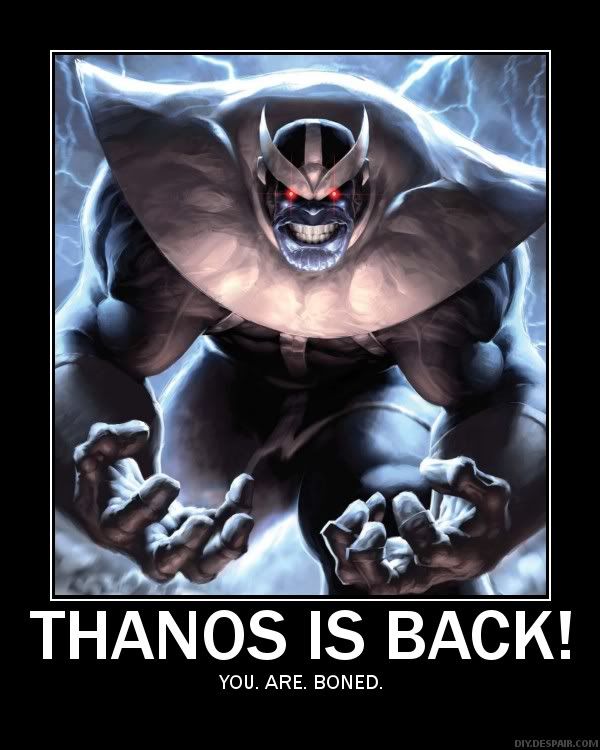
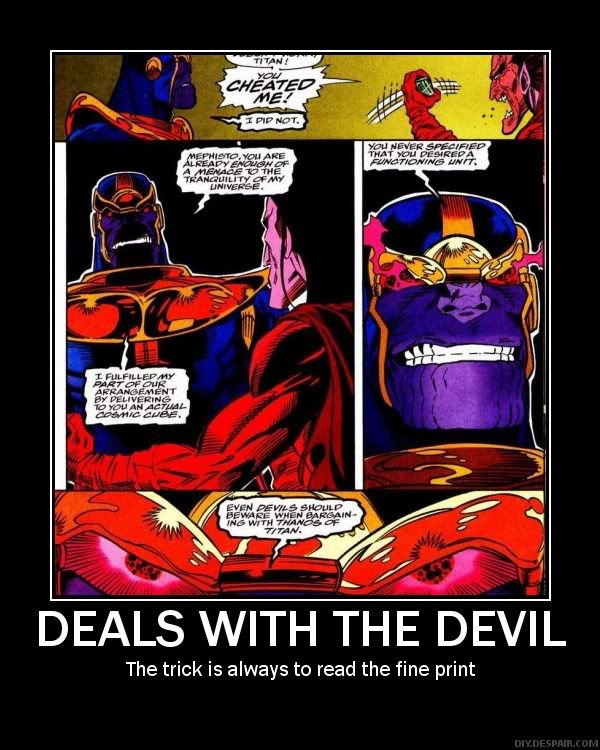
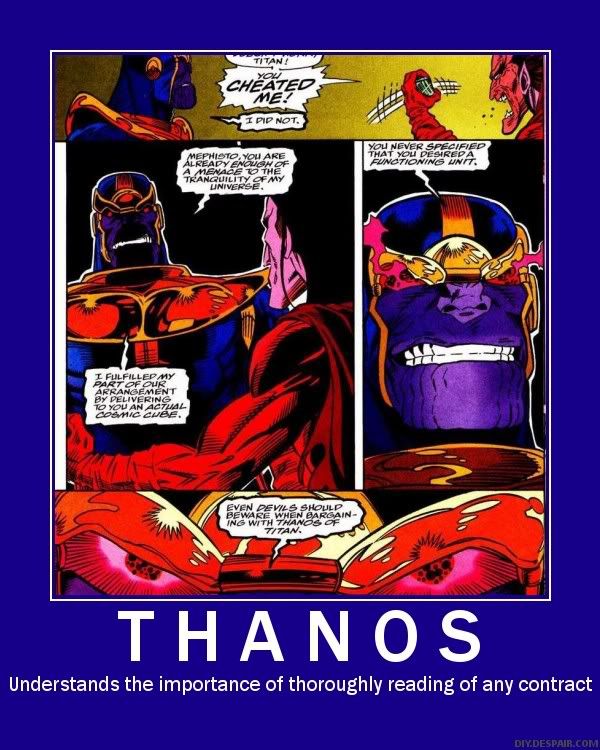
Thanos is great, probably because unlike some villains, he doesn't show up very often (usually he's dead between appearances, which helps with this sort of thing) so he's not as overexposed as say, Doom or Magneto.
Your one-stop shop for comics-related fake motivational posters. Also, other things.
Sunday, November 14, 2010
Cosmic Retrospective: THANOS
Thanos is great, probably because unlike some villains, he doesn't show up very often (usually he's dead between appearances, which helps with this sort of thing) so he's not as overexposed as say, Doom or Magneto.
Saturday, November 13, 2010
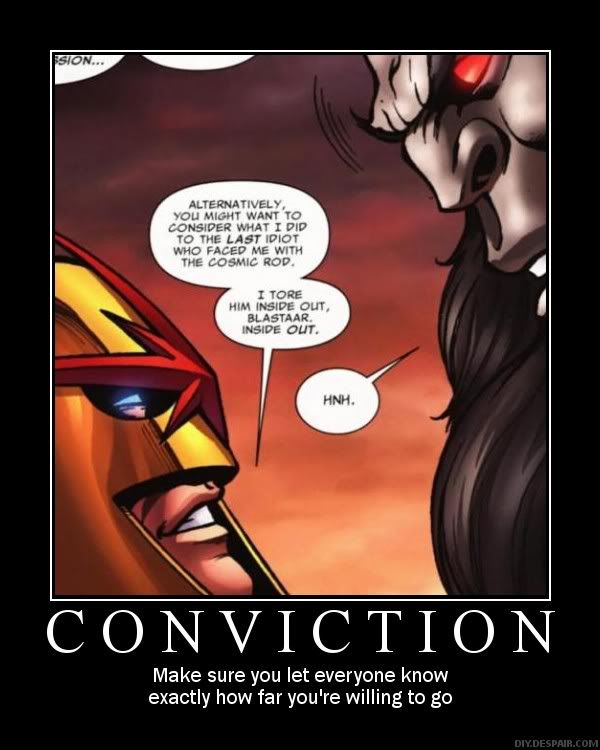
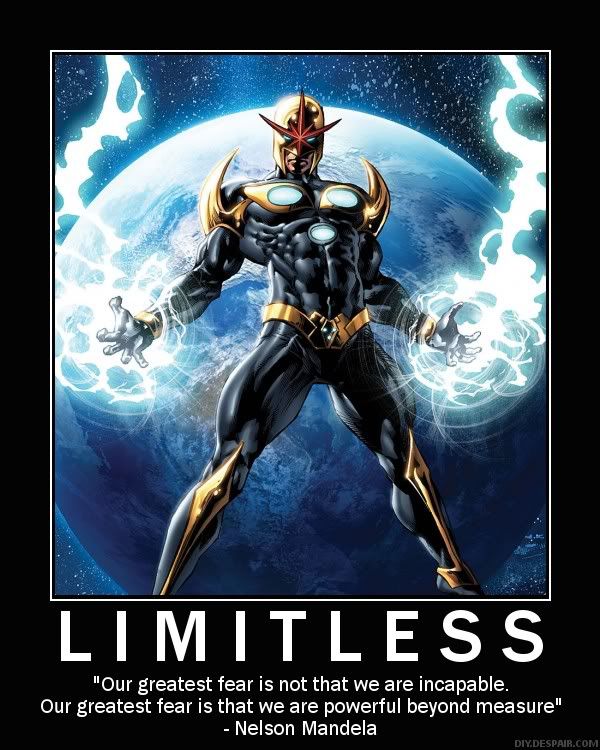
Cosmic Retrospective: NOVA
Friday, November 12, 2010
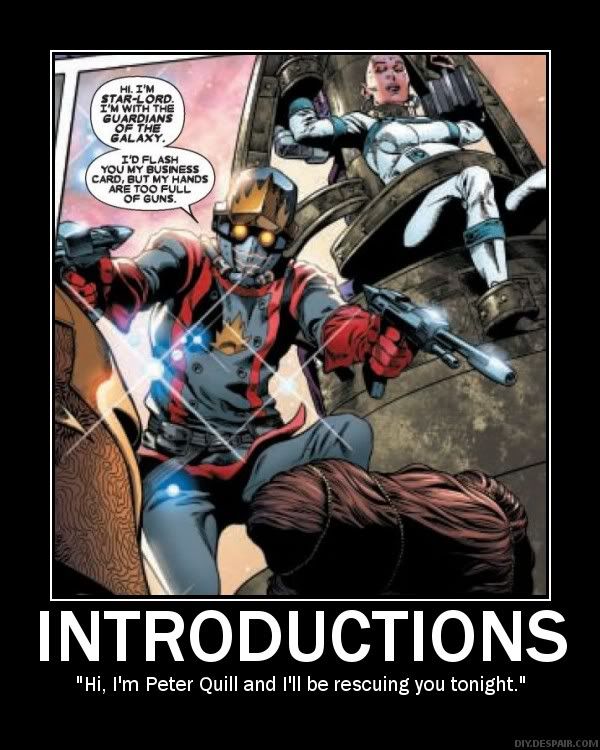
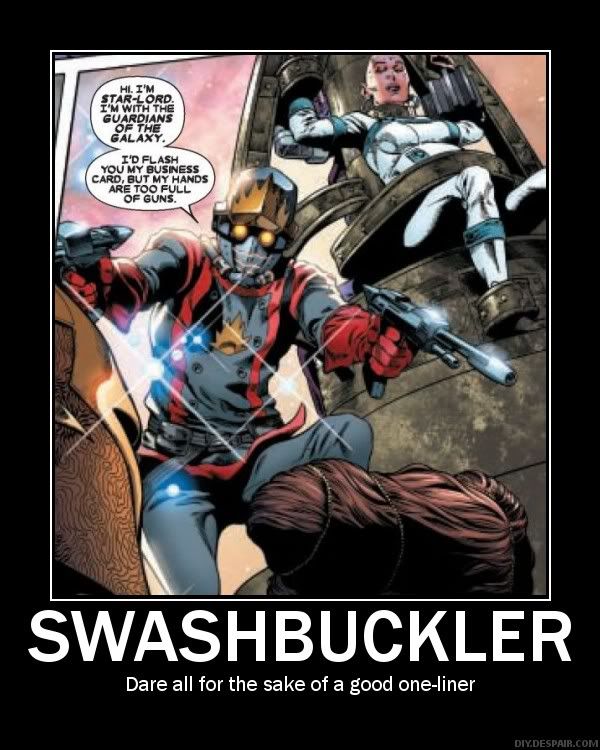
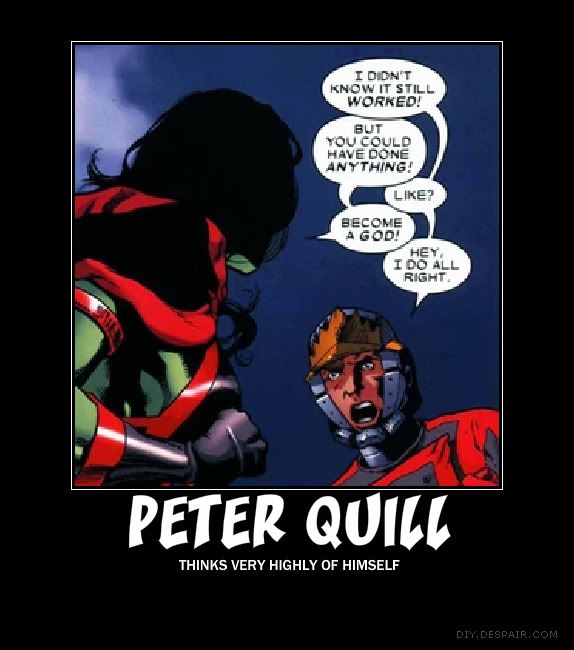
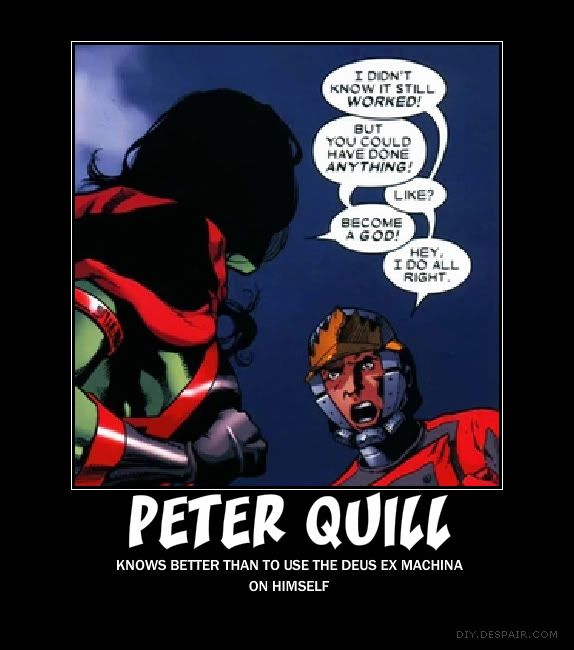
Cosmic Retrospective: STARLORD
It's one thing to take a character who had a moderate amount of popularity (say, enough to sustain a series ever decade or so) and bring that character into the limelight again. It's an altogther astonishing thing to take a character that was NEVER popular and make them the centerpiece of an ensemble cast. And yet, that's exactly what happened with Peter Quill, the once and reluctantly-yet-again Starlord.
And let's face facts - as a leader, he wasn't all that great. He got by more on seat of his pants than any kind of real planning. He was an adaptive, not proactive thinker. More of an everyman reluctantly put into the role of cosmic wariror. Grounded, down-to-earth, and self-depricating. Pretty much the perfect point of view character.
Thursday, November 11, 2010
Wednesday, November 10, 2010
Cosmic Ponderings
The last issue of the Thanos Imperative ships today, and with it, a likely end to the cosmic universe stories as we've known them for the past 3-4 years. I'll probably spend some time looking at the events, but only after I take a look at the last issue. Cheers.
Labels:
Guardians of the Galaxy,
motivational posters,
Nova
Tuesday, November 09, 2010
Monday, November 08, 2010
Sunday, November 07, 2010
Saturday, November 06, 2010
Saturday is for Gamers
Labels:
Avengers,
Deadpool,
Fantastic Four,
Galactus,
Gamers,
Hank Pym,
Rogue,
Spider-Man,
Thor,
X-Men
Friday, November 05, 2010
MASKED Review Part 3
Downfall by Joseph Mallozzi is probably my favorite story in this collection - a look at an ex-villain dragged into a final assignment, who learns more about his past than he ever wanted to. Straightforward, smart and snappy, Mallozzi knows how to give us just enough information to make us put together the puzzle by ourselves, and yet hold back enough to let the final reveal be a surprising treat.
Mark Chadobourn offers a novel tale of power, redemption, and betrayal in By My Works You Shall Know Me. While fans of the genre may not find much new here, the plot works along fine, even if only the protagonist is ever fleshed out as a character. However, given the nature of the protagonist and the narration, I believe that was a necessary conceit to make the story work.
Fans of alternate histories, particularly those of a steampunk bent, will find a lot to enjoy in Call Her Savage by Marjorie M. Liu. Liu offers what (to me at least) is a clever twist on a cliche - a reluctant old warrior called back to duty for a last desperate battle. Of course, in this case, neither the old warrior nor the battle are entirely as first advertised. For me at least, my own familiarity with the genre conventions ended up tripping me at least a couple times here, and it's to Liu's credit that it was clearly laid out to mislead jaded fans such as myself.
A bit overly sentimental and threadbare at times, Ian McDonald manages to pull off a nice little story about old age and superpowers and the bond between old foes in Tonight We Fly. While there are few surprises here, it's still a very competent effort that helps ground the fantastical elements in the real world.
This brings us to the final story in this collection, A to Z in the Ultimate Big Company Superhero Universe (Villains Too) by Bill Willingham. Now, Willingham has garned a reputation among comics fan for some of his political beliefs and for some other online comments he has made to fans. Now, I tried to read this story without thinking about those comments, because I think that a work and the personal beliefs of the writer should be separated to give an unbiased opinion of the work itself. In that light, this was a lighthearted, exceptional clever (giving the sub-chapters alphabetical names was a cute and innovative way of helping to give the necessary background on some of the multitude of characters) bit of work that shows that Willingham has an imagination for world-building and new characters that hasn't had a chance to shine in the current climate (at the very least, not since his Elementals days). It's a very successful effort on his part that clearly illuminates his talent.
Unfortunately, it also highlights a couple of his quirks that were not to my taste. While his knowledge of things mythological and fairy tale are prodigious (as one should expect of the co-creator of Fables and the creator of the Elementals) there is something of an over-reliance on the supernatural evident in this work, like all of it. In his defense, this is a minor quibble of mine, but it was one that reminded me why I'm not a regular fan of his. The other item of annoyance is more significant - while it's very clear (particularly in the online comments he's put above) that he's no fan of current "Superhero Decadence" (and I for one, would like to thank him for coining this term), he's not really interested in promoting the more traditional "Silver Age" moral codes either, preferring his own hybrid of the two. While there's nothing wrong with this, it would have been nicer if he had not created such obvious strawmen from both of these camps to deflate in the story. It would have been far better for him to actually offer up his philosophy for the genre's moral core unhindered by comparison, so it could stand on its own merits. That said, I did enjoy this story, as evidenced by the fact that I've spent so long talking about it.
Overall, while there were a few flubs and non-starters, this is an excellent anthology that I would recommend to any genre enthusiasts looking for some more innovation from the superhero genre.
Thursday, November 04, 2010
MASKED Review Part 2
Daryl Gregory offers what is probably the most meta story in this book in Message from the Bubblegum Factory. Even after reading it, I'm still left wondering if it's as much an indictment of the fans of the superhero genre, or if it is simply a clever story about the connection between fans, creators, and the fictional universes they uphold. Implications aside, it's a rapid-paced action story that leaves you with a lot of questions, and precious few answers.
If you're surprised by the black comedy and bittersweet tragedy of Thug, then you really don't know much about Gail Simone. And that's all I need to say on this score.
Vacuum Lad by Stephen Baxter is more science-fiction than your typical cape and mask fantasy story, but it's made that much more compelling by a richly realized and well conceived future Earth backdrop. Owing more to Isaac Asimov than Jack Kirby, we are treated to a young man's unlikely journey into adulthood and a new world that is immediately familiar and alien at the same time.
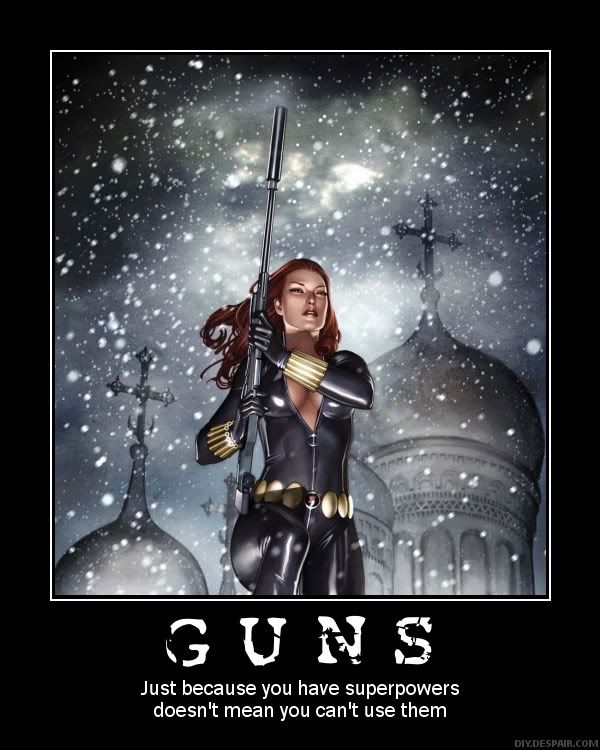
A Knight of Ghosts and Shadows by Chris Roberson is the most pulp-influenced tale in this tome - full of dark avengers, supernatural thrills and tragic twists. What seperates this from generic pulp homages is the attention to characterization and the struggle to maintain humanity in the face of the inhuman.
Headcases is a story by the husband and wife team of Peter and Kathleen David. Actually, that's not entirely fair -there really isn't much story here - just a couple of scenes with little build-up or payoff. It might work as a teaser for a larger work, but it falls dissappointingly flat.
Labels:
motivational posters,
reviews,
Secret Six,
Superman
Wednesday, November 03, 2010
MASKED Review Part 1
I recently finished the new superhero Anthology MASKED, and I thought I'd spend some time and give you a quick review of the various stories within. To make it a little easier, I'll spread it out over the next few days, and include some unrelated posters.
So, we begin:
Cleansed and Set in Gold by Matthew Sturges is a nice introduction to this anthology - a tale of a hero with a dark secret set against a major global conflict. Sturges' does a good job in setting the stakes, and keeping the protagonist relatable and sympathetic where he could have been seen as pathetic or even opportunistic. It's the stuff of good cable dramas, but at the same time, the morality of the tale is decidedly grey, despite attempts to sweep that away that are not particularly convincing. Though I would imagine that's part of the point.
You would think that after all these years there wasn't a genre trope in superhero comics that hadn't been touched, but Where Their Worm Dieth Not by James Maxey proved me wrong there. It's a clever look at one of the gimmicks that supehero comics, even now, still take for granted, and it's a solid, albiet, dark tale.
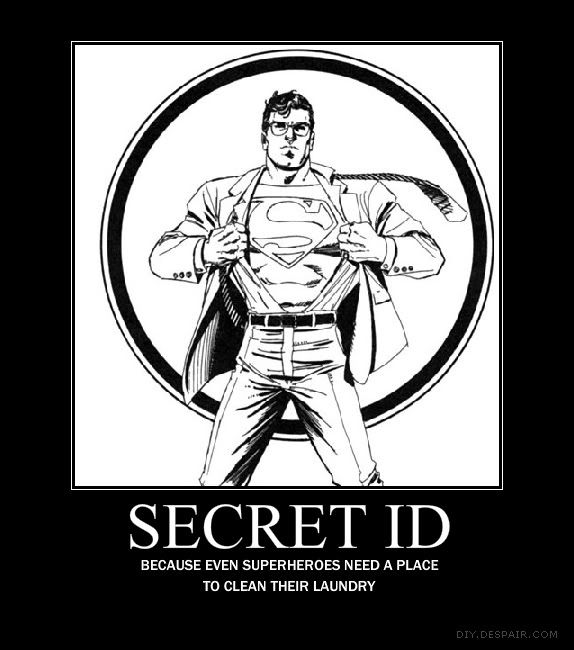
You like Paul Cornell, right? Well, then you'll like Secret Identity, as he brings his usual mix of humour and maturity to a story about identity (duh), social connections and relationships.
Mike Carey gives us an action-packed, tense heist thriller with superpowers in The Non-Event. An intelligent story, with creative takes on superpowers and unintentional tragedy.
Mike Baron (yes, that Mike Baron) offers up a story not unlike "Kick-Ass" in Avatar, with a story of "real vigilantism". However, Baron is more thoughtful and introspective as to both the motivations of a would-be crimefighter, as well as to the consequences. As one would expect from Mike Baron, this story pulls no punches in a sympathetic portrayal of a confused would-be hero, and how his actions play out in the context of a world not governed by fictional shorthand.
More to come...
Labels:
Black Widow,
Fantastic Four,
motivational posters,
reviews
Tuesday, November 02, 2010
Monday, November 01, 2010
Sunday, October 31, 2010
Saturday, October 30, 2010
Friday, October 29, 2010
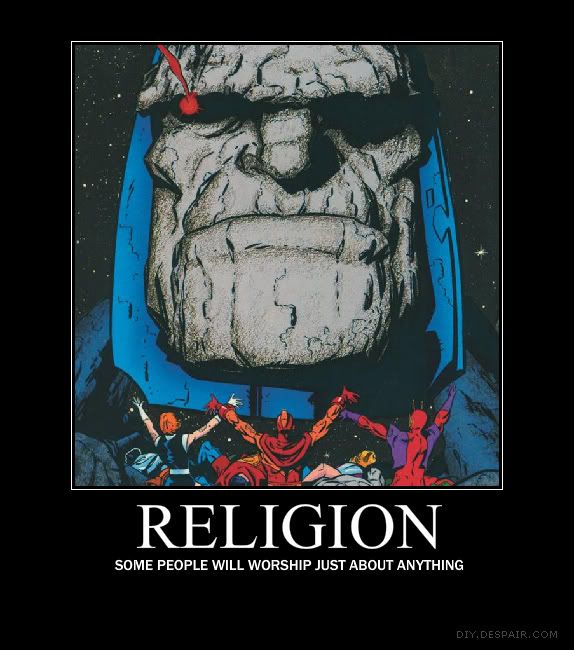
Religion in a comic universe
There are two primary schools of thoughts regarding how the events that occur in a superhero comic universe would impact religion.
1) No fundamental change - sure there might spring up the occasional flash cult for a certain superhero (this happens to Superman occasionally), but for the most part, things would stay the same, with the superheroes with the names of mythological gods dismissed as impersonators or just guys who liked the name.
2) Major fundamental changes with entire religious structures dedicated to superbeings.
Both of these are a little simplistic, and don't really account for all factors.
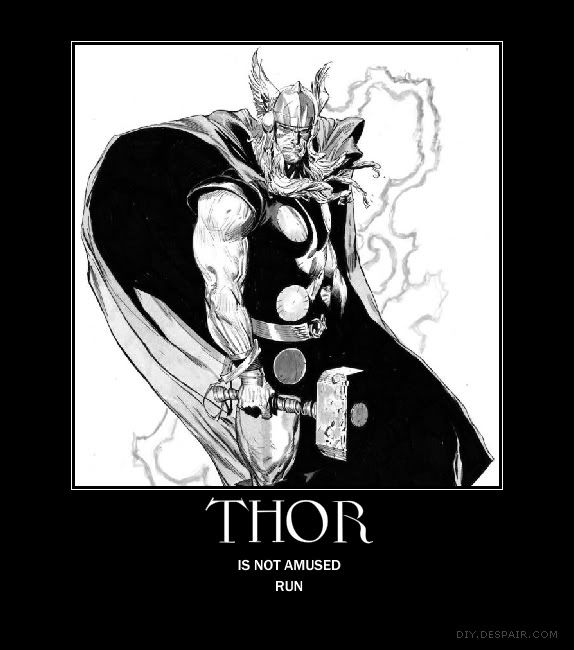
First, the argument that the mythology-based superheroes are simply extra-dimensional beings is a double edged sword - while it could be used to keep a Church of Thor from springing up, it would also be used by the Richard Dawkins types to discredit contemporary religious figures. It doesn't take much imagination to see how "Christ was a Mutie!" could have a very fractious impact on modern Christianity, and the same holds true of every other modern religion. After all, once you've argued that one "god" is a super-alien, it opens the door to say they all are/were - which reduces every religion to a simple affiliation - like picking which sports team is your favorite or your political party identification.
The flip side of course, would be the false messiahs - as every fringe radical religious organization with minimal scruples and maximum ambition would be promoting their own "super-savior" figure - a mutant or meta or enhanced or enchanted human to use to promote that theirs is the one true way. This promotion would likely involve a bodycount.
Next, with the frequent Resurrections of famous superbeings, the question of the afterlife would seem answered - particularly with the existence of someone like the Spectre or the firsthand accounts of superhumans who've been beyond the veil (Green Arrow, Superman, the Fantastic Four, etc). Of course, every reporter and theologian on Earth would be constantly hounding them for exact details of their experiences to try and match them with their own belief systems. And in areas where they would conflict, one would imagine religious scholars and pundits of all stripes to do their best to discredit the accounts entirely. Of course, discrediting does nothing to solve the larger issue of what happened, as the alternatives lead to a lot of questions - particularly "why do only super-people, even ones without powers, come back from the dead?" And there are no good answers there.
And of course, you could start looking into all sorts of things the existing religious institutions would be trying to maintain legitimacy or, if possible, claim supremacy. It's not too much of a stretch from real life to imagine a group of Vatican scientists (no, that's not an oxymoron - go read it for yourself) using a dimensional portal to contact Heaven, and accidentally opening a portal to, let's say, the Dark Dimension or Apokalips.
So, needless to say, the oversimplification of religion in comics, while it is done for good reasons to avoid offending sensibilities, does close off some rather amusing story opportunities.
Thursday, October 28, 2010
Superfolks and the problems with good satire
OK, so one of my birthday gifts this year was a copy of Superfolks.
The good news is that I thought it was very good and worth a read...but....
Part of what a good satire should do, regardless of whatever genre it's lampooning, is effectively capture the zeitgeist, and the flavor and culture of the times. Superfolks does this really well, but that's part of the problem for a modern reader - if you have no idea who the characters in "All in the Family", "The Mary Tyler Moore Show" or the minor figures of 1970s American political scene, some of the jokes fall flat.
This strikes as me as part of the problem with modern "deconstructionism" in supercomics - while they do alright at lampooning superhero genre tropes, they rarely tie in those tropes to the times people are living in. The fiction is a reflection of the larger culture it's in, and by not getting the proper context, modern superhero satire is just a satire of a subculture, and not the larger culture that creates and shapes it. Without this element, the audience is challenged to have the correct context necessary to appreciate just how much is being satirized.
Labels:
Elektra,
Legion of Superheroes,
reviews,
Spider-Man
Wednesday, October 27, 2010
Why the Superman Movie might not suck
OK, so there's been some talk about the upcoming Nolan produced and now Zack Snyder-directing Superman movie. While there's been some strong negative reactions on the internets, here are somethings to consider:
Zack Snyder being involved all but guarantees that Superman will punch something. That is a good thing.
It is a GOOD thing that so far, everyone involved isn't a die-hard Superman fan. Consider the results of die-hard fanboyism from say, Jeph Loeb, Bryan Singer, and of course, Kevin Smith. The ability to look at things critically may not be a bad one.
Seriously, is there anyone other than Nolan that could or should be trusted with a Superman film franchise? It wasn't going to be Jon Faverau or Joss Whedon - they are on Marvel projects.
The more I think about, the more I think it's a good thing that Smallville and Superman Returns existed. No matter what your opinion of them, they served some useful purpose in providing useful guideposts. Superman Returns clearly illustrated the weaknesses in wallowing in the nostalgia of the Donner/Reeve films, and Smallville has helped to narrow down what aspects of the Superman mythos work with modern audiences (and some that won't).
Now, this isn't all good news and lord knows there's a really good chance this'll tank, but I'm not prepared to bring the hammer down before I hear more than vague rumors.
Subscribe to:
Posts (Atom)